Best Gambling Ad Network: Why FroggyAds Delivers Casino Traffic That Converts
Choosing the best ad network for gambling is less about finding the biggest traffic pool and more about finding the traffic you can actually use. Gambling and casino offers operate under licensing rules, age gates, geo-restrictions and vertical approval policies that general-purpose networks rarely handle well. That is why an advertiser who buys on headline impressions often ends up with a campaign that looks busy in the dashboard but produces few registrations, deposits or approved accounts. At FroggyAds, the positioning for this niche is clear: it is built around launching push, native, display and pop campaigns on 750+ SSP sources with transparent controls, which makes it a sensible candidate to evaluate for Gambling and Casino offers that depend on high converting traffic. This article focuses on how to verify that claim with your own numbers before committing budget.

Defining the Real Requirements Before You Compare Networks
The first step is separating headline reach from usable traffic. A network can report a very large supply of impressions, but for gambling the relevant figure is the inventory that accepts your creatives in your target GEO, on your target device, under your licensing status. Licensing rules, age verification requirements and vertical approval policies all reduce the eligible pool, sometimes dramatically. Ask for vertical-approved placements broken down by country and device, and treat any vague answer as a warning sign. When comparing options, many advertisers look at best gambling ad networks that document their licensing acceptance and GEO coverage clearly, since those details determine how much of the reported inventory is actually usable.
Set the kill thresholds, the attribution window and the scaling steps before launch, and scale only when the accepted-event data holds across more than one mature window
- A network may accept gambling traffic in general while excluding a specific product type, such as crypto casinos or sportsbooks in certain markets
- Confirm that the network accepts your exact offer in each market, that age-verification and responsible-gambling requirements can be met, and that geo-filtering happens before billing
- The network should support S2S postbacks, persistent click identifiers and sub-ID reporting at the level of placement and cohort, and its numbers should reconcile with your own analytics on a sample of days
- Finally, define a clear path from test budget to scaled spend
Next, map your offer type to the sources that allow it. A casino, a sportsbook, a poker product and a crypto casino each face different placement restrictions, and not every format accepts every category. A sportsbook offer may clear a native placement in one market and be rejected in another, while a crypto casino may be excluded from several formats altogether. Build a short table of offer type, permitted GEOs and permitted formats before you talk to any network, so that the first conversation is about inventory you can really buy.
Finally, define the conversion path you actually need to pay for. A click is cheap to buy and tells you little about value. A registration shows intent, a first deposit shows commitment, and an approved account shows that the lead passed verification. Choose the event that matches your economics, because the network you pick will be judged against that event rather than against the cost of the first interaction. Many teams begin by reviewing a shortlist of best gambling ad networks against this same set of requirements, so that every candidate is measured on identical criteria.
Preparing Your Test Budget, Offers and Tracking
Before any money moves, confirm that you have server-to-server postback or equivalent tracking in place, a landing page that will pass compliance review, and a deposit-based goal configured in your analytics. Without a postback that carries the click identifier through to the deposit event, you cannot tie revenue back to the placement that produced it. Check whether the network supports S2S postbacks, how click IDs persist across redirects, and whether sub-IDs are available for reporting by placement.
Build a test matrix by GEO, device and creative angle, and assign a fixed daily cap to each segment. Keep the matrix small: one or two GEOs, two devices and two or three creative angles is usually enough to read a signal without splitting delivery into fragments too thin to judge. Equal budgets across segments make the comparison fair, and fixed caps stop one segment from absorbing the test while the others sit idle.
Set the attribution window in advance, and do not judge any segment before it has closed. For many gambling funnels a 48 to 72 hour window is a reasonable starting point, because registrations, deposits and verification approvals arrive with delay. Write the window into the test plan, together with the rule for how late events are counted, so that a Tuesday snapshot is never compared against a Friday one.
Running a Structured Traffic Test Step by Step
Launch in a fixed order. Start with one GEO, two creatives, one landing page variant and equal budgets, and add complexity only after the first read is clean. Changing the GEO, the creative and the landing page at the same time makes it impossible to say which variable produced the result, and that is the most common reason gambling tests end without a usable answer.
During the early stage, watch three checkpoints: creative approval rate, click-to-registration ratio and fraud signals. A high rejection rate tells you that the creative or the landing page needs work before the test can be trusted. A click-to-registration ratio that is far below the other segments points to a mismatch between the ad promise and the destination. Fraud signals such as clusters of clicks with identical timing, abnormal session lengths or repeated device fingerprints should be investigated before you draw any conclusion from the numbers.
Read the data with care, because click-through rate alone misleads on gambling traffic. A creative with a strong CTR can attract curiosity clicks that never register, while a lower-CTR creative may send fewer but far more committed visitors. Judge each segment by its accepted action per unit of spend, and look at the deposit-level outcome once the cohort has matured.
Evaluating Traffic Quality Through Compliance and Fraud Signals
Age gate and geo-restriction handling are the first quality filters. Traffic that arrives from a country where the offer is not licensed, or from an audience that cannot pass the age gate, will be rejected or will generate chargebacks and account closures. Check whether the network applies geo-filtering before the click is billed, and whether its age-verification flow is compatible with your landing page. A network that bills for clicks you cannot legally convert is shifting compliance risk onto your budget.
Bot, click-injection and incentive traffic have recognisable indicators in gambling verticals. Watch for clicks that never load the page, registrations that cluster in seconds rather than minutes, deposits made with the same payment instrument across many accounts, and sessions with no scrolling or interaction. Incentivised users, who click for a reward rather than to play, inflate the top of the funnel and depress the approved-depositor rate. Ask the network how invalid traffic is filtered, whether third-party verification is accepted, and what share of traffic is removed before billing.
Use a short checklist of quality criteria when comparing networks: approval speed for creatives and placements, pre-moderation rules for offers, support for account verification flows, and the availability of a named contact who understands gambling policy. These criteria say more about long-run value than a headline reach figure, because they determine how quickly you can fix a problem and how often a placement is pulled mid-campaign.
Scaling Winning Segments Without Breaking Approval
Increase budgets gradually. A common discipline is to raise spend in modest steps while watching deposit quality and any changes to payout caps, because a sudden jump in volume often pulls in lower-intent traffic and can trigger a review. After each increase, allow the cohort to mature before the next step, and record the previous budget and the rollback condition so that you can return to a trusted configuration quickly. Before scaling any campaign, it is worth reviewing the complete set of criteria in the Full article, which outlines how to log each budget step and define a rollback point if quality metrics start to slip.
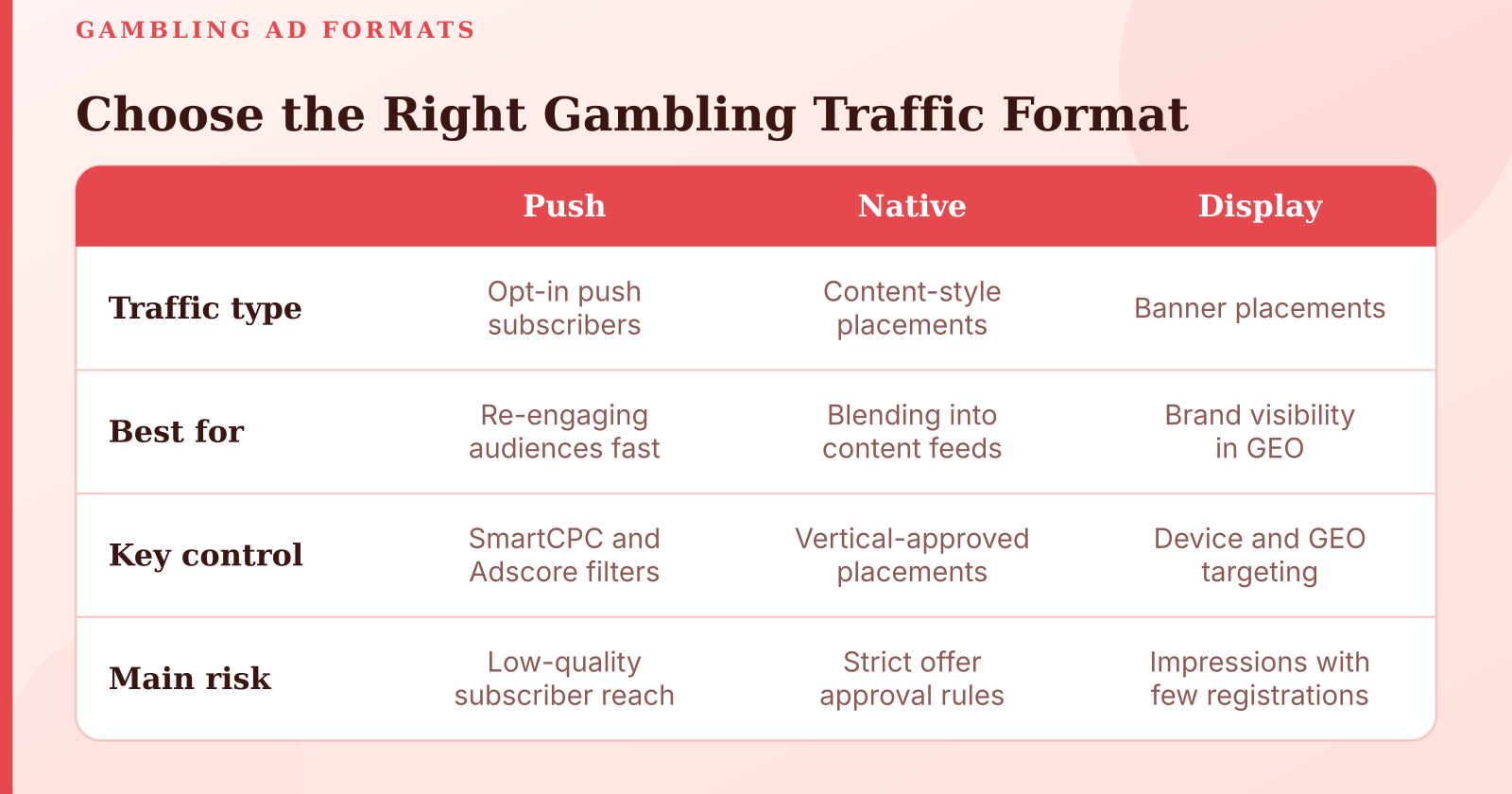
Expand to new GEOs only after the first segment reaches its target return. Each new market brings its own licensing position, its own age rules and its own user behaviour, so the test should be repeated on a smaller scale rather than assumed to transfer. Treat a new GEO as a fresh test with its own kill threshold, not as an extension of a proven one.
When you iterate on creatives and landing pages, keep them inside vertical policy. Guaranteed-win language, misleading bonus wording and missing responsible-gambling information are the usual causes of rejection, and a rejected creative can stall a segment that was performing well. Make changes in small, documented steps, and confirm each new version against the policy before it goes live.
Common Mistakes Advertisers Make When Choosing a Gambling Network
The most frequent error is buying on the cheapest CPM and ignoring deposit-level conversion. A low CPM looks efficient in the first report, yet if the traffic produces few deposits the effective cost per depositor can be far higher than a more expensive source. Always carry the analysis through to the event that generates revenue.
Testing too many variables at once is the second common error. When geography, format, creative and landing page all change together, the results cannot be attributed to any single cause, and the test produces opinions rather than decisions. Keep one major variable under test at a time.
Judging a network after 24 hours is the third. Attribution lag in gambling funnels means that early numbers understate the value of later-arriving deposits and approvals, so an early verdict often rejects a source that would have performed. Wait for the agreed window to close before deciding.
The fourth mistake is a mismatch between the offer's restrictions and the network's approved verticals. Confirm approval for your exact offer and destination, not for the category as a whole.
Final Checklist for Selecting a Gambling Ad Network
Start with compliance and licensing fit for your target GEOs. If any of these fail, no amount of reach will make the campaign viable.
Next, check tracking flexibility and postback reliability. Discrepancies that nobody can explain are a reason to pause scaling.
Then review transparent traffic sourcing and fraud controls. You need a clear account of where traffic comes from, how invalid events are filtered, and what share is removed before billing. A network that cannot explain this in concrete terms is asking you to absorb the risk. FroggyAds is one option to evaluate against these criteria, alongside other candidates, using your own market and your own deposit numbers as the deciding evidence. The network that proves its value on your figures, rather than the one with the largest headline reach, is the one worth committing to.